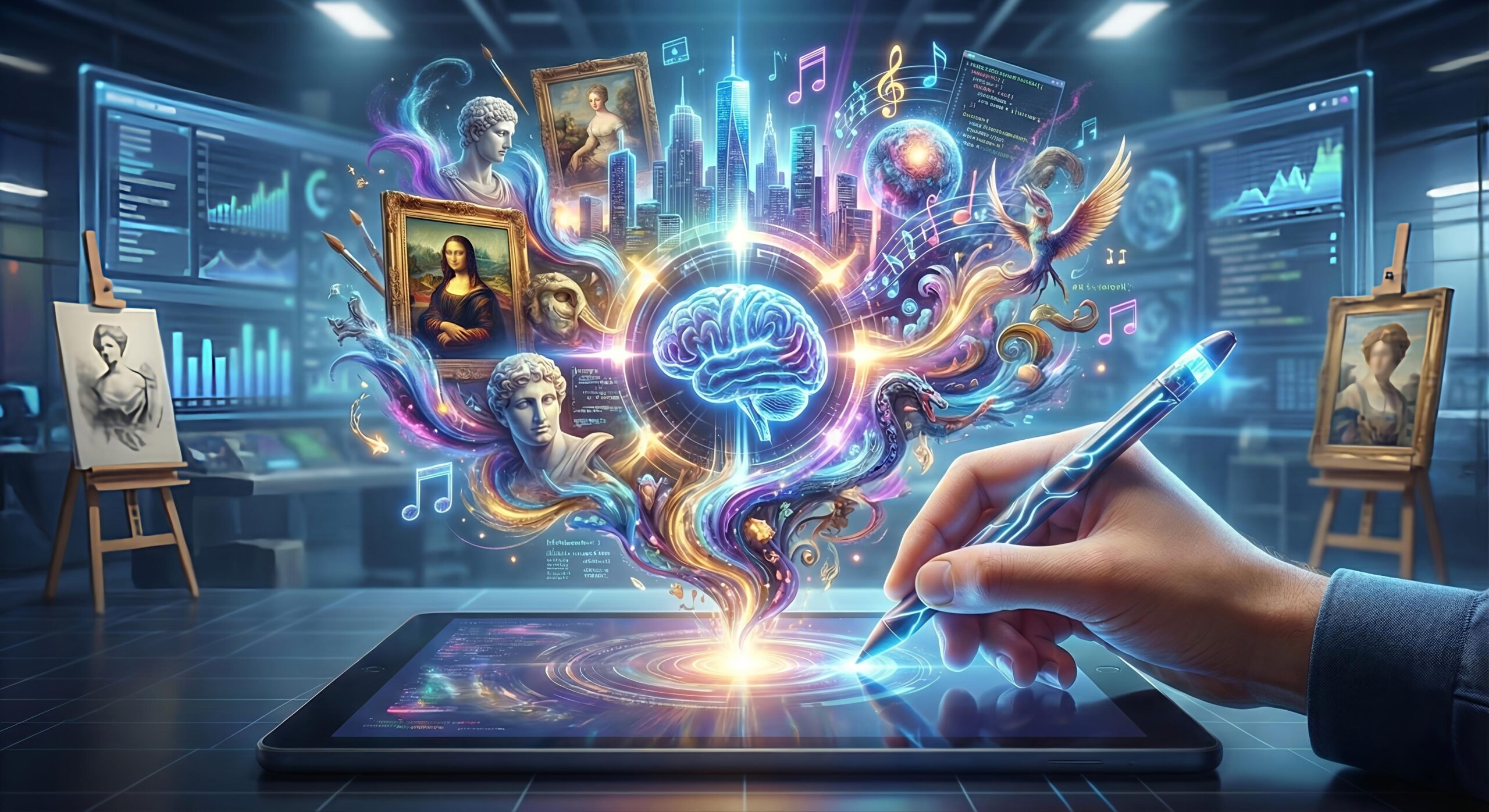
In an age where technology continuously blurs the line between imagination and innovation, Generative Artificial Intelligence (AI) is emerging as the ultimate creative superpower. From designing art and writing prose to crafting music and developing code, generative AI has revolutionized how humans conceptualize and produce creative work. Once considered a futuristic concept, it’s now an active partner in shaping culture, design, entertainment, and business strategy.
The Rise of Generative AI: How It Works
Generative AI refers to machine learning models capable of creating new content that mimics human creativity. Unlike conventional AI, which processes or categorizes data, generative AI thrives on the creation of new information—text, images, sounds, or even entire virtual environments. These models use deep learning techniques such as transformers, generative adversarial networks (GANs), and large language models (LLMs) like ChatGPT or Google’s Gemini.
In simple terms, generative AI studies existing data and patterns to predict or “generate” new possibilities. For example, a model trained on millions of images can craft an entirely new artwork that’s original yet stylistically consistent with its training dataset. Similarly, a language model can write scripts, poems, blog posts, and even code based on a user’s prompt.
This shift represents a paradigm change in creativity — one where AI no longer replaces humans but enhances them, acting as a collaborator that amplifies imagination’s limits.
👉 https://ai.google/learn-ai-skills/
The Evolution of Creativity: From Tools to Partners
Historically, every major leap in creativity has been driven by a technological catalyst. The invention of the printing press democratized literature; photography transformed artistic expression; the computer unleashed digital creativity. Now, Generative AI is ushering in a new era — where machines don’t just assist but co-create.
Unlike static tools, generative AI adapts, learns, and evolves. This allows artists, writers, marketers, and developers to prototype ideas faster and explore possibilities that might be impossible through human effort alone. It’s not about replacing talent but expanding its reach.
For instance:
- Graphic designers use AI to brainstorm new design languages.
- Marketers generate personalized campaigns for millions of users simultaneously.
- Filmmakers use AI to visualize scripts or create realistic storyboards within minutes.
Generative AI effectively becomes an intelligent collaborator, not just a digital assistant.
Why Generative AI Is a Creative Superpower
1. Endless Ideation at Lightning Speed
One of the greatest advantages of generative AI is its limitless generation capacity. Creative professionals often face “idea fatigue” — the mental slowdown that comes after prolonged brainstorming. With AI, creators can generate infinite variations of an idea within seconds. Whether it’s testing multiple ad headlines, drafting novel plots, or composing background music, AI removes the exhaustion from experimentation.
This accelerates creative workflows, allowing professionals to focus on refinement, originality, and emotional depth rather than repetitive tasks or blank-page anxiety.
2. Empowering Non-Creatives to Create
Generative AI democratizes creativity. People who once lacked the technical skills to draw, produce music, code, or design can now express themselves effortlessly. With tools like Midjourney, Runway ML, and ChatGPT, anyone can bring ideas to life through natural language prompts.
This shift turns creativity into a universal human right, no longer reserved for those with specialized training. It enables more voices, styles, and stories to enter the cultural conversation — enriching creativity worldwide.
Looking for the best AI tools for creators?
👉 Check out our curated list of AI tools here →
3. Data-Driven Inspiration
AI’s access to massive datasets allows it to uncover trends and generate content aligned with public interests. Instead of guessing what resonates, creators can use AI insights for evidence-based creativity.
For instance, generative AI tools can analyze audience preferences and recommend mood boards, tones, or themes suited for specific markets. This combination of emotional storytelling and analytical precision makes campaigns more effective and authentic.
4. Accelerating Innovation in Every Industry
Generative AI is transforming not just art but business. In product design, AI can propose new shapes and structures that optimize performance. In gaming, it generates entire virtual worlds. In architecture, AI helps visualize construction projects before they’re built.
Industries embracing generative AI see rapid improvement in speed, efficiency, and creative exploration. The fusion of creativity and computation opens up previously unimaginable possibilities — from AI-composed symphonies to customized educational materials.
Generative AI in Action: Real-World Examples
The impact of generative AI is tangible across various fields:
- Marketing and Content Creation: Brands use AI to generate blog posts, social media campaigns, ad copies, and personalized content. It helps increase productivity and maintain consistency across channels while optimizing SEO.
- Fashion Design: Designers use AI to generate new clothing concepts, explore patterns, and even simulate materials to visualize potential products.
- Film and Entertainment: AI assists in scriptwriting, editing, and character design, helping directors visualize concepts faster.
- Gaming Industry: Developers use AI to design levels, create interactive narratives, and procedurally generate realistic environments.
- Music and Audio Production: Tools like AIVA and Soundful help musicians compose original melodies or refine existing tracks.
- Education and Research: Generative AI supports personalized learning experiences and content creation, making knowledge more accessible globally.
Each application demonstrates how AI becomes a co-creator, merging human intent with machine intelligence.
Balancing Automation and Authenticity
While generative AI offers immense potential, it also raises an important question: Can creativity be truly authentic if produced by a machine?
The answer lies in how humans use AI. True creativity doesn’t come solely from output but from intent, emotion, and context. AI may provide ideas, but it’s humans who give them meaning. Consider AI as the wings that let creative thinkers soar higher — but the direction, story, and emotion always come from the human heart.
Ethical considerations are also crucial:
- Ownership: Who owns AI-generated content — the user, the tool, or the dataset it learned from?
- Bias: Since AI reflects its training data, it can perpetuate stereotypes if not carefully managed.
- Misinformation: Deepfakes and synthetic media highlight the dangers of misused creativity.
Responsible AI frameworks must ensure transparency, accountability, and respect for human artistry.
The Human–AI Partnership: Creativity Multiplied
The most powerful innovation emerges when humans and AI work together. This collaboration transforms creativity from a solo act into a multidimensional experience.
Artists now consult AI models for inspiration, using them as partners in ideation. Writers use AI to overcome creative blocks, while developers rely on it for faster, more efficient prototyping. In marketing, generative AI helps tailor messages to unique audiences, improving engagement rates and brand loyalty.
The synergy between human intuition and machine intelligence defines the modern creative process — blending emotion and algorithm, passion and precision.
SEO and Generative AI: A Perfect Match
In digital marketing, SEO (Search Engine Optimization) thrives on relevant, engaging, and informative content. Generative AI elevates SEO strategies by producing keyword-optimized text that aligns with search intent while maintaining high readability.
Here’s how generative AI empowers SEO professionals:
- Keyword optimization: AI tools analyze trending queries and integrate them naturally into content.
- Semantic search alignment: Modern SEO isn’t about keyword stuffing but about contextual relevance. AI models understand user intent and build content ecosystems that answer real questions.
- Content freshness: AI-driven tools can continuously update existing content to align with new trends.
- Meta content creation: Automated generation of titles, meta descriptions, and FAQs improves click-through rates and discoverability.
As search engines become smarter, human–AI collaboration allows digital marketers to craft content that’s authentic, optimized, and valuable to readers.
Challenges Ahead: What Still Needs Improvement
Despite its power, generative AI is still evolving. Some common challenges include:
- Data Bias: AI creativity is limited by the quality of its training data.
- Ethical Ambiguity: Intellectual property laws struggle to define ownership for AI-generated work.
- Over-Reliance: Excessive dependence on AI tools might reduce human originality and emotional storytelling.
- Content Saturation: As AI-generated content floods the web, maintaining authenticity and differentiation becomes harder.
Creators and organizations must balance the efficiency of automation with the soul of human creativity to sustain meaningful innovation.
The Future of Generative Creativity
Generative AI is still in its early stages, yet its trajectory points toward a world where every creative person has an intelligent partner. Future models will not only generate ideas but understand aesthetic preferences, emotions, and audience impact with greater nuance.
The next wave of generative technology might include:
- Hyper-personalized creativity: AI tailored to individual artistic voices.
- Multimodal fusion: Combining text, sound, and visuals seamlessly in one creative ecosystem.
- Ethical AI standards: Frameworks that ensure fairness, credit, and responsibility.
- Immersive virtual co-creation: AI-powered spaces where humans and algorithms sculpt digital realities together.
Generative AI will not replace humans—it will elevate them, helping us reach levels of innovation once thought impossible.
Conclusion: The Dawn of a New Creative Era
Generative AI is more than a technological advancement; it is the new creative superpower of the digital age. By transforming algorithms into collaborators, it empowers creators to dream bigger, move faster, and achieve more than ever before. The brush, pen, and keyboard are no longer just tools—they are extensions of an intelligent system that learns, adapts, and evolves alongside us.
As we step into this hybrid age of human and machine creativity, one truth remains: the most beautiful works will always come from the fusion of data and imagination, logic and love, code and creativity. Generative AI isn’t replacing the artist—it’s helping every one of us become one.
Leave a Reply