
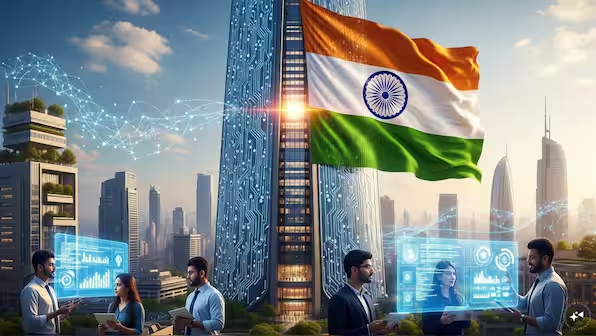
India’s transformation into a global tech powerhouse symbolizes national pride, perfectly aligning with Republic Day celebrations. This ascent reflects decades of innovation, policy reforms, and a vibrant workforce driving the digital economy forward.
Historical Foundations
India’s tech journey began post-independence with institutions like IITs established in the 1950s, fostering engineering talent. By the 1990s, economic liberalization sparked the IT boom, turning cities like Bangalore into “Silicon Valley of the East.”
The Y2K crisis positioned Indian firms as reliable global outsourcers, with companies like Infosys and TCS leading exports. Today, these roots support a sector contributing over 8% to GDP, employing millions.
Government initiatives like Digital India (2015) accelerated broadband access and e-governance, laying infrastructure for tech dominance. This evolution underscores Republic Day’s theme of self-reliance or Atmanirbhar Bharat.
Booming IT Ecosystem
India’s IT spending is projected to hit $176 billion by 2026, fueled by data centers and AI software. Bangalore, Hyderabad, and Pune host thousands of startups and MNCs, with over 5 million in Global Capability Centers (GCCs).
GCCs from Google, Microsoft, and Amazon employ skilled workers for R&D, automation, and cloud services. Tech Mahindra’s Google Cloud CoE and IBM’s Pune Automation Center exemplify innovation hubs advancing banking, healthcare, and retail.
In 2026, data center growth at 20.5% annually supports AI infrastructure and data localization, attracting foreign investment. This ecosystem positions India as the third-most attractive destination for tech investments worldwide.
AI and Emerging Tech Leadership
India needs over a million AI and data science professionals by 2026, per NASSCOM, spurring programs like Future Skills Prime. Startups like Krutrim and Sarvam AI develop vernacular language models, rivaling global giants.
Generative AI adoption in content creation, as relevant for bloggers, boosts productivity without coding—tools automate SEO while ensuring originality. Government pushes via IndiaAI Mission allocate funds for computing power and ethics.
Web3 innovations, including stablecoins and asset tokenization, promise efficient payments and liquidity, enhancing financial tech. India’s 1.4 billion population offers unmatched data for training ethical AI systems.
Vibe coding explained as the new era of AI-driven software development where developers build applications by describing ideas instead of writing traditional code
Startup Surge and Unicorn Boom
India minted over 100 unicorns by 2025, with Flipkart, Byju’s, and Paytm leading. Funding hit $25 billion in 2024 despite global slowdowns, driven by fintech and edtech.
Tier-2 cities like Indore and Jaipur emerge as hubs, reducing Bangalore’s overload. Republic Day highlights stories of founders like Ritesh Agarwal (Oyo), embodying entrepreneurial spirit.
Policies like Startup India provide tax breaks and IP fast-tracking, fostering 1 lakh+ startups. This boom creates jobs for engineering students and content creators researching trends.
Government Policies Driving Growth
Production-Linked Incentive (PLI) schemes for electronics and semiconductors aim for $300 billion production by 2026. Semiconductor plants by Tata and Micron signal self-sufficiency.
National Quantum Mission and 5G rollout enhance computing and connectivity. Data protection laws build trust for global firms.
As President Trump notes U.S.-India tech ties, bilateral deals amplify growth. These reforms celebrate Republic Day’s unity in progress.
Global Talent and Diaspora Impact
India produces 1.5 million engineers yearly, with cost-effective skills drawing MNCs. Diaspora leaders like Google’s Sundar Pichai and Microsoft’s Satya Nadella inspire return migration.
Reverse brain drain via remote work and GCCs retains talent. English proficiency and time zone advantages make India ideal for 24/7 operations.
Economic Impact
Tech employs 5.4 million directly, with BPM adding millions more. Exports reached $194 billion in 2025, funding infrastructure.
Middle-class expansion demands gadgets, boosting R&D. By 2030, consumer tech innovation will explode, per WEF.
India’s fourth-largest economy status entering 2026 reflects resilience.
Key Cities as Tech Hubs
These hubs decentralize growth, optimizing talent distribution.
Challenges Ahead
Skill gaps in AI ethics and cybersecurity persist, addressed by upskilling via Coursera and NPTEL—ideal for bloggers like TechHub creators. Infrastructure strains demand sustainable data centers.
Geopolitical tensions require diversified exports. Yet, India’s adaptability shines.
In addition to vibe coding tools, check out our 2026 tech stack for automation to streamline your entire development workflow.
Future Outlook: 2030 Vision
By 2030, India eyes $350 billion IT exports, leading in 6G and quantum. Metaverse and AR/VR for gaming hardware will boom, aligning with consumer electronics interests.
As a tech blogger, leverage this for SEO content: target “best gaming laptops India 2026” or “AI tools for content creators.” Republic Day 2026 marks a pivotal year.
India’s tech rise inspires global partnerships, proving democracy fuels innovation. Jai Hind!
FAQ’s
1. Why is India considered a global tech powerhouse today?
India combines a massive skilled workforce, strong engineering education, cost-effective innovation, and supportive government policies like Digital India and Startup India. This ecosystem has made India a preferred hub for IT services, AI, startups, and global capability centers.
2. How has Republic Day influenced India’s technological journey?
Republic Day symbolizes India’s self-governance and policy-driven growth. Many transformative tech initiatives—such as Digital India, PLI schemes, and IndiaAI Mission—reflect constitutional values of innovation, equality, and self-reliance (Atmanirbhar Bharat).
3. What role does AI play in India’s tech future?
AI is central to India’s growth, with applications in governance, healthcare, fintech, and content creation. Indigenous AI models, vernacular language tools, and government-backed skill programs position India as a leader in ethical and scalable AI solutions.
4. Which Indian cities are leading the tech revolution?
Bangalore, Hyderabad, Pune, Mumbai, Chennai, and emerging Tier-2 cities like Indore and Jaipur drive innovation across software, fintech, cloud computing, manufacturing, and AI—ensuring decentralized and inclusive tech growth.
5. How can students, engineers, and bloggers benefit from India’s tech boom?
Students gain access to high-demand careers in AI, cybersecurity, and cloud computing. Engineers find global opportunities via GCCs and startups, while bloggers and creators can leverage AI tools, tech trends, and SEO-driven content to grow digital careers.
Leave a Reply