
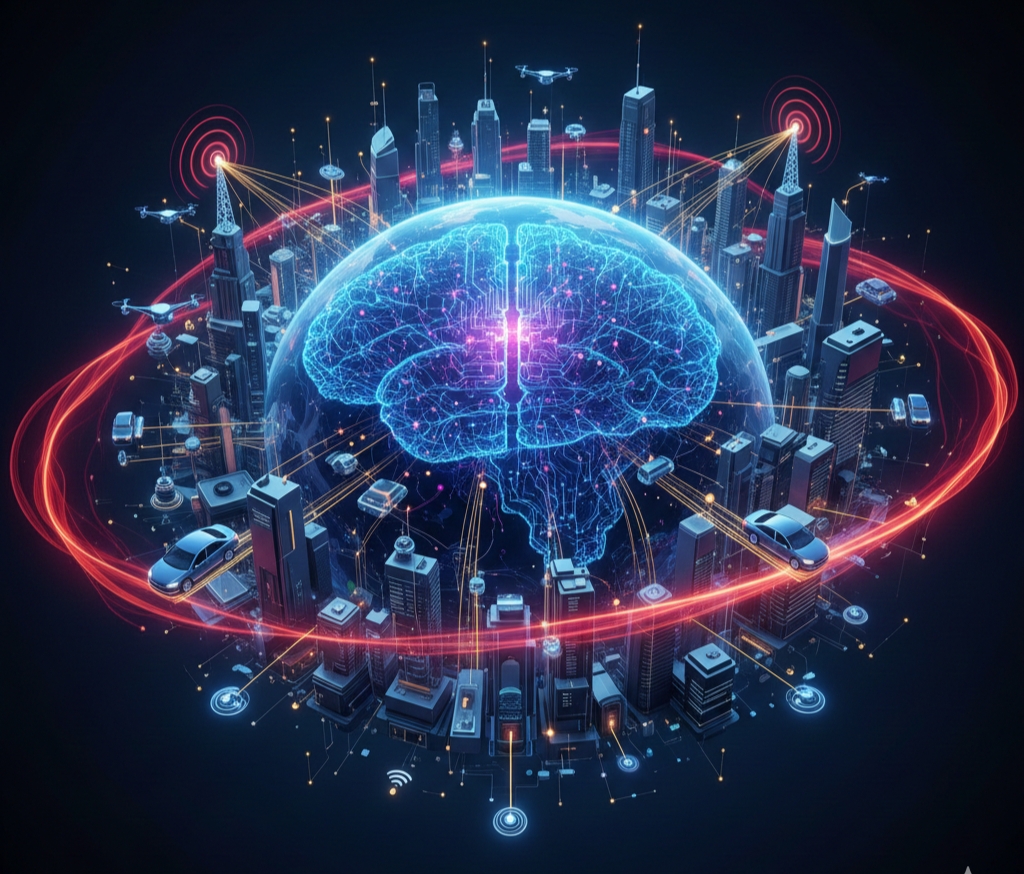
What Makes AI, IoT & 5G So Powerful
AI, IoT, and 5G are individually important, but their real strength comes from convergence—when billions of devices (IoT) connect through ultra‑fast networks (5G) and are controlled by intelligent algorithms (AI). This convergence creates “intelligent connectivity,” where data is continuously collected, transmitted, and analysed in real time to automate decisions and optimize systems.
- IoT connects physical objects like sensors, machines, vehicles, and wearables so they can send and receive data.
- 5G offers ultra‑low latency, high bandwidth, and massive device density, allowing millions of IoT devices to communicate simultaneously.
- AI analyses this flood of data, identifies patterns, predicts events, and takes automated actions at the edge or in the cloud.
Together, they transform passive systems into active, learning, and adaptive digital ecosystems that can respond instantly to real‑world changes.
How Each Technology Complements the Others
Each of the three pillars plays a specific role in this new digital superpower, and their synergy is what unlocks the future potential.
Role of IoT: Sensing the Physical World
IoT is the “digital nervous system” that captures data from the physical world. From smart meters and CCTV cameras to factory robots and connected cars, IoT devices continuously monitor environment, movement, performance, and behavior.
- In smart cities, IoT sensors track traffic, air quality, energy usage, and public safety in real time.
- In healthcare, wearables and remote monitors capture vital signs for continuous health tracking.
Without IoT, AI and 5G would lack the real‑world data needed to generate insights and automate decisions.
Role of 5G: The High‑Speed Digital Highway
5G is the ultra‑fast, ultra‑reliable highway that moves IoT data where it needs to go, almost instantly. Its low latency, high bandwidth, and support for massive device density make previously impossible scenarios—like remote surgery or fully autonomous vehicles—realistic.
- 5G networks support real‑time communication between devices, edge nodes, and the cloud, with latency often measured in milliseconds.
- It enables new applications like industrial automation, AR/VR, and mission‑critical control systems that require highly responsive connectivity.
Without 5G, IoT networks can easily become slow, congested, and unreliable at large scale.
Role of AI: The Digital Brain
AI is the “brain” that turns raw data into predictions, automation, and intelligent decision‑making. It can run in the cloud or at the edge, close to the data source, allowing systems to react in real time.
- AI models can detect anomalies, optimize resource usage, and predict failures before they happen.
- Edge AI allows devices and gateways to process data locally, reducing bandwidth, improving privacy, and enabling faster decisions.
Without AI, IoT and 5G would only move data around; they would not create smart, autonomous behavior.
Real‑World Use Cases: Where the Superpower Is Visible
The convergence of AI, IoT, and 5G is not just a theory; it is already transforming multiple industries and public services.
Smart Cities and Intelligent Infrastructure
Smart cities are one of the clearest examples of this new superpower in action. Thousands of IoT sensors combined with 5G networks and AI systems enable city authorities to monitor and manage everything from traffic to utilities in real time.
- Traffic lights can adapt dynamically to congestion patterns using AI‑based traffic monitoring, reducing travel time and emissions.
- Smart lighting, parking, and waste management systems use IoT sensors and AI optimization to cut costs and improve services.
This leads to safer, cleaner, and more efficient urban environments that evolve as the population grows.
Autonomous and Connected Mobility
Future mobility depends heavily on AI, IoT, and 5G working together. Connected cars act as IoT nodes packed with sensors, cameras, and communication modules, while 5G delivers the low‑latency links needed for real‑time decision‑making.
- Advanced driver assistance systems use AI to analyse sensor and video feeds, improving safety and providing predictive alerts.
- Autonomous vehicles rely on 5G for high‑speed data exchange with infrastructure, other vehicles, and cloud or edge AI systems.
This intelligent mobility ecosystem promises fewer accidents, smoother traffic, and more efficient logistics networks.
Industry 4.0 and Smart Manufacturing
Factories of the future are being built on the foundation of AI‑enabled IoT, powered by private 5G networks. This setup supports flexible, highly automated production environments with real‑time monitoring and control.
- IoT sensors on machines feed continuous performance data into AI systems that perform predictive maintenance, reducing downtime and costs.
- 5G allows wireless industrial robots and automated guided vehicles to move and coordinate safely in real time, avoiding the limitations of wired systems.
This combination is key to Industry 4.0, where factories become adaptive, efficient, and tightly integrated with digital supply chains.
Healthcare and Remote Medicine
Healthcare is another sector where the AI‑IoT‑5G combo is becoming a literal life‑saving superpower. High‑speed, low‑latency connections enable real‑time monitoring and advanced remote care.
- Wearable devices and home health sensors (IoT) continuously stream patient data to AI systems that detect anomalies and trigger alerts.
- 5G‑enabled telemedicine and even remote robotic surgeries become feasible, thanks to predictable latency and reliable bandwidth.
The result is more personalized, proactive care and better access to specialist treatment, even in remote areas.
Why This Trio Becomes a Future “Superpower”
Calling AI, IoT, and 5G the new future superpower is not an exaggeration; they form a foundational layer that will quietly power the next generation of products, services, and even economies.
Economic, Business, and Innovation Impact
By enabling real‑time automation and insight‑driven decisions, the AI‑IoT‑5G combo unlocks huge productivity and innovation gains. Organizations can shift from reactive operations to predictive and autonomous models across sectors like manufacturing, transport, agriculture, retail, and public services.
- Intelligent connectivity will modernize “virtually every sector,” from logistics and utilities to education and government.
- Edge AI and 5G are projected to support large new markets in robotics, private networks, and real‑time analytics at industrial scale.
Businesses that master this stack can build smarter products, reduce waste, and create entirely new digital services and revenue streams.
Role of Edge Computing and Edge AI
Edge computing and edge AI amplify this superpower by bringing intelligence closer to where data is generated. Instead of sending everything back to centralized cloud servers, processing happens at local gateways, base stations, or even directly on devices.
- Edge AI reduces latency, bandwidth usage, and dependency on constant cloud connectivity, which is critical for mission‑critical use cases like industrial control, autonomous systems, and telemedicine.
- The market for edge AI is expected to surge as more companies adopt 5G and IoT for real‑time analytics and automation.
This architecture makes the AI‑IoT‑5G ecosystem more resilient, scalable, and secure by design.
Challenges, Risks, and Opportunities Ahead
Like any superpower, this technological convergence comes with responsibilities and risks that must be managed carefully. Security, privacy, interoperability, and ethical AI will be central issues as deployments scale.
- Massive IoT and 5G networks expand the attack surface, making robust cybersecurity and secure‑by‑design architectures essential.
- AI transparency, data governance, and regulatory compliance will shape how organizations are allowed to use data and automation.
For students, professionals, and creators, this space offers huge career and innovation opportunities in areas like AI engineering, data science, network engineering, IoT development, cybersecurity, and edge computing. Those who understand how AI, IoT, and 5G work together will be better positioned to build, secure, and lead the intelligent systems that will define the next decade.
Leave a Reply