
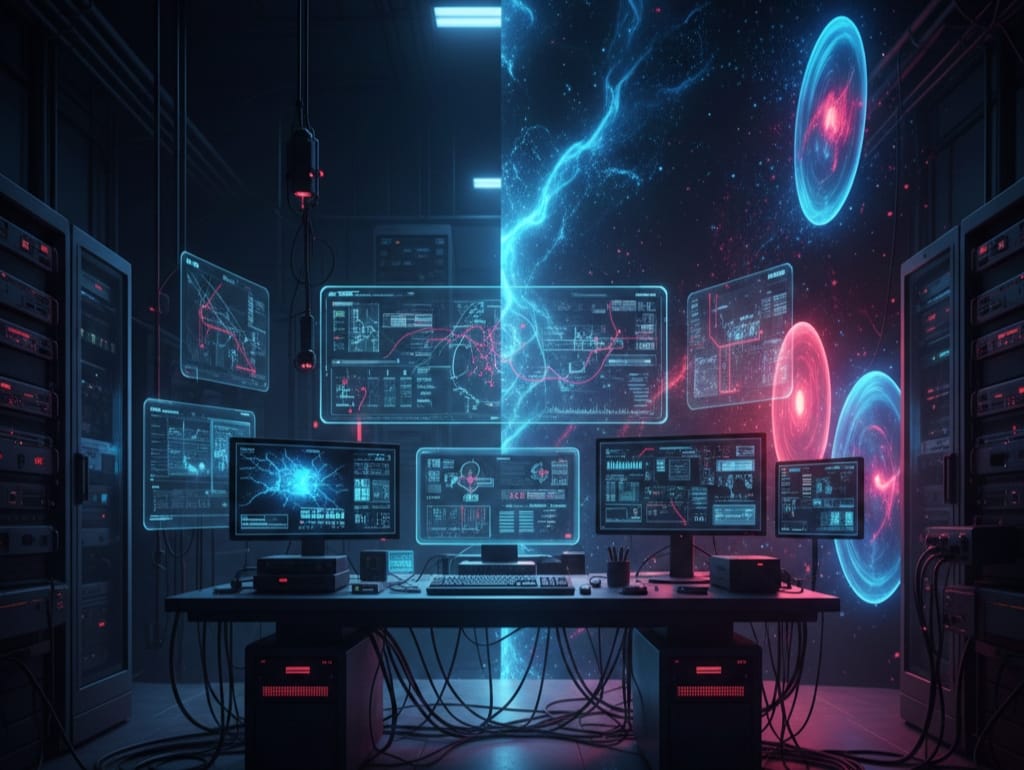
Technology has always mirrored human imagination, and the world of Stranger Things is no exception. Set in the eerie town of Hawkins, this cult-favorite series blends nostalgia with supernatural science. As we move into 2026, the technological landscape has advanced dramatically — smart systems think faster, networks predict patterns, and AI blurs the boundary between human and machine. But what if the technologies that exist — or are emerging — today could power a real tech stack inspired by Stranger Things?
The Intersection of Pop Culture and Technology
In 2026, pop culture no longer stays confined to screens. It merges effortlessly with real innovations. The Stranger Things universe thrives on elements such as telekinesis, dimensional rifts, predictive capabilities, and secret government technology. Similarly, the real-world tech stack in 2026 reflects advancements in quantum computing, artificial intelligence, and immersive simulation. The line between science fiction and practical tech is shrinking faster than ever.
Shows like Stranger Things fuel tech imagination — encouraging scientists, developers, and tech entrepreneurs to ask bold questions like: Can parallel universes be simulated computationally? Can machine learning predict human emotion or energy fluctuation? The answers lie in the ongoing technological revolutions shaping 2026.
The Real Tech Stack of 2026
As we step deeper into digital transformation, let’s define what the tech stack of 2026 looks like. A tech stack is the combination of tools, frameworks, programming languages, and hardware that power systems, networks, and applications. Inspired by the Upside Down universe and the Hawkins Lab experiments, our futuristic “Stranger Things Tech Stack” includes cutting-edge elements like:
- Quantum Processing Units (QPU)
- AI-driven Predictive Neural Frameworks
- Decentralized Data Architecture
- IoT-based Environmental Monitoring
- Mixed Reality Engines
- Neural Interface Systems
- Next-Generation Cybersecurity Models
Each of these layers echoes themes from Stranger Things: mystery, intelligence, energy manipulation, and parallel dimensions.
1. Quantum Computing — The Portal to the Upside Down
In Stranger Things, the portal to the Upside Down is opened through high-energy experiments. In 2026, real-world parallels exist in quantum computing. Quantum processors harness qubits capable of existing in multiple states simultaneously — a phenomenon resembling the duality of parallel universes.
Modern companies like IBM, Google, and D-Wave have pioneered quantum supremacy, but in 2026, we’ve moved far beyond theoretical performance. Quantum platforms now integrate with traditional cloud stacks, performing tasks impossible for classical systems.
Applications inspired by the series:
- Simulating multidimensional spaces or parallel world physics.
- Predicting nonlinear time behavior and cosmic energy distributions.
- Modeling human consciousness for advanced AI predictions — similar to Eleven’s psychic sensing abilities.
The quantum processor is the real-world “gate” — not to another reality, but to another state of computational intelligence.

2. Artificial Intelligence as the Eleven of Our Era
If the Hawkins team had access to 2026’s AI, Eleven wouldn’t be the only one capable of extraordinary perception. Artificial Intelligence has evolved into transformative intelligence — capable of emotional resonance, independent reasoning, and real-time creativity.
Generative AI (like GPT systems, Midjourney, or AudioLM) now merge seamlessly with edge devices, allowing distributed cognition. 2026’s AI stack mimics human-style learning through multi-modal neural networks that process video, sound, and biometric data simultaneously.
Sample components of the 2026 AI layer:
- Neural Cloud API: Handles cognitive functions across connected devices.
- Emotion Synthesis Algorithms: Enable empathy-based responses.
- Predictive Analytics Engines: Forecast behavioral trends like “Demogorgon detection” — anomaly identification within data environments.
- Contextual Intelligence Models: Understand location-based triggers — like Hawkins’ electromagnetic anomalies.
This AI layer is the digital form of Eleven — protective yet immensely powerful, capable of sensing disruptions before they occur.
3. IoT and Environmental Awareness — Monitoring Hawkins in Real Time
In Stranger Things, strange events often manifest as power fluctuations, signal distortions, or electromagnetic interference. Imagine if Hawkins Lab had smart IoT systems running advanced sensors linked to AI analytics. By 2026, this is not imagination — it’s reality.
IoT-driven technology stack includes:
- Smart Sensor Mesh Networks: Detect environmental shifts like EM surges, temperature fluctuations, or radiation spikes.
- Autonomous Drones: Map real-time data of “phenomenon zones” using AI-linked LIDAR.
- Edge Computing Nodes: Process data at the source to reduce latency, crucial for disaster prediction.
- Predictive Maintenance Systems: Similar to analyzing Hawkins’ energy grid for dimensional instability.
These technologies not only serve in industrial or climate domains but could easily power a real-life Stranger Things-inspired surveillance network. Advanced IoT systems today already perform “energy anomaly” detection in smart cities, which isn’t too far from identifying portals to the Upside Down.
4. Mixed and Extended Reality — The Mindscape Interface
A standout aspect of Stranger Things is its exploration of consciousness — from Eleven’s mind-space explorations to psychic bridges across dimensions. In 2026, extended reality (XR), including AR and VR, allows humans to visualize digital data as if walking through it.
XR technologies powering this paradigm:
- Neuro-visual Headsets: Render real data models inside immersive environments.
- Holographic Projectors: Display live simulations of “dimensional fields.”
- Spatial AI: Maps emotional and sensory data into dynamic 3D scenes.
- Tactile Feedback Gloves: Provide physical sensation for digital interactions.
Metaverse applications in 2026 are more purpose-driven — for mental health therapy, military training, scientific simulation, and creativity. Imagine scientists entering a “neural VR lab” to visualize quantum fluctuations or emotional waveforms from AI systems.
This blend of psychology and technology turns the Upside Down into an understandable, researchable simulation environment.
5. Neural Interface Systems — The Eleven-Tech Connection
One of the most futuristic — yet rapidly real — technological innovations of 2026 is the neural interface. Companies like Neuralink, Synchron, and Kernel have made immense progress in connecting human neurons directly with computers.
Such interfaces can now:
- Transmit thoughts into machine commands.
- Record emotion-linked brain wave data.
- Enable real-time telepresence through shared neural patterns.
The 2026 neural tech framework mirrors Eleven’s telepathic link with minds across the Upside Down. Users can send signals, access remote data spaces, or even “think” commands to robots or AI assistants.
Ethical layers:
While neural link systems expand possibilities, debates echo the ethics of Stranger Things experiments — privacy, identity, and consent remain central. In 2026, governments globally enforce neurodata protection laws, ensuring that thought streams are not misused for conditioning or surveillance.
6. Data Decentralization — Escaping Hawkins Lab’s Central Control
If the Hawkins Lab represented centralized manipulation, the modern digital world is moving toward decentralization. Blockchain and Web3 technologies dominate 2026’s internet foundation, enabling transparent, independent ecosystems.
Stranger Things-inspired applications:
- Decentralized Data Vaults: Prevent single-point data control — ensuring no single authority can exploit information (unlike Hawkins’ secretive network).
- Edge-Blockchain Integration: Combine IoT sensors with secure distributed ledgers for tamper-proof phenomena logging.
- Digital Identities (DIDs): Empower users like Eleven to “own” their data and memories.
- Smart Contracts for Ethics: Embed rule-based access into experimental technologies, maintaining AI transparency.
Decentralization is 2026’s answer to the shadowy control structures that series like Stranger Things critique. It empowers individuals while keeping tech systems open and verifiable.
7. Next-Gen Cybersecurity — Fighting the Digital Demogorgon
Every technological marvel attracts shadowy threats — both literal and virtual. The digital equivalent of the Demogorgon is ransomware, deepfake deception, and AI-generated misinformation. In 2026, cybersecurity has become more autonomous, predictive, and adaptive.
Key defenses in the 2026 security stack:
- Quantum-encrypted communication: Uses post-quantum cryptography to secure networks.
- Bio-authentication: Gait, iris, and brainwave patterns replace passwords.
- Adaptive AI Defense Grids: Detect anomalies like living neural systems in networks (bringing sci-fi alive).
- Darknet Intelligence Engines: Predict security breaches before they manifest.
Security no longer reacts — it learns and evolves, much like the creatures from the Upside Down. The difference lies in purpose: defense through prediction, not suppression.
8. Narrative Computing and Emotion AI
In the world of Stranger Things, emotion drives the plot as much as the monsters. In 2026, Emotion AI and narrative-based computing are taking psychological modeling to new heights. Systems now detect human moods via micro-expressions, cortisol data, or voice inflections — converting emotions into quantitative inputs.
Applications:
- Mental health diagnostics that simulate “feelings maps.”
- Interactive entertainment adapting narrative based on the user’s emotional state.
- AI storytellers dynamically creating arcs reflecting mood — much like an adaptive Stranger Things episode written by your own subconscious.
This evolution of computing aligns with human empathy rather than cold logic — technology that feels, not just analyzes.
Building a Stranger Things-Inspired Tech Stack in 2026
To conceptualize a practical application, here’s a sample “StrangerTech 2026” stack that merges imagination with emerging technology layers:
| Layer | Technology | Function |
|---|---|---|
| Base Hardware | Quantum Cloud Infrastructure | Core computation & parallel simulations |
| Edge Layer | IoT Mesh + Edge Computing | Environmental sensing (EM, heat, vibration) |
| AI Layer | Multi-modal Neural Networks | Pattern recognition, anomaly detection |
| Experience Layer | XR Interface (Neural VR) | Immersive visualization, telepresence |
| Security Layer | Quantum Encryption + Blockchain | Privacy and protection |
| Interaction Layer | Brain-Computer Interface (BCI) | Thought-command integration |
| Ethical Layer | Smart Contract Governance | Moral safeguards for experiments |
This holistic architecture could theoretically monitor dimensional “anomalies,” simulate multi-realities, and foster safe experimentation — ethically guided by decentralized systems.
Technology That Feels Supernatural — Yet Real
The allure of Stranger Things lies in making the supernatural feel almost scientific. Similarly, the best technologies of 2026 seem wondrous yet logical. Concepts like computational consciousness, quantum awareness, and synthetic empathy no longer belong to fantasy. They emerge as legitimate research domains blending physics, neuroscience, and computing.
In Hawkins, fear came from the unknown. In 2026, curiosity replaces fear as technology turns imagination into exploration. The same questioning spirit that opened doors to the Upside Down now opens realms of infinite simulation, responsible AI, and emotional computing.
The Vision Beyond Hawkins — Technology as Collective Imagination
The technological arc from 1980s Hawkins to 2026 represents humanity’s evolution from mystery to mastery. Stranger Things teaches that understanding the unknown transforms fear into possibility. In this sense, technology is our collective Eleven — amplifying intuition, connectivity, and exploration.
The real Upside Down isn’t a dark mirror of our world but a reflection of untapped potential within human creativity and computation. Each innovation — from quantum AI to emotion sensors — brings us closer to decoding the mysteries that once felt like science fiction.
By 2026, Stranger Things stops being just a story. It becomes a metaphor for technology’s journey — from power to purpose, secrecy to transparency, and imagination to realization.
Leave a Reply